Here's the open secret of agentic development: your AI coding agent is only as good as the context you hand it. Claude Code, Cursor, and GitHub Copilot can write a service in minutes — but without your architecture in their context window, they'll happily invent their own. Direct database calls from the frontend? Sure! A sneaky import across service boundaries? Why not!
The fix is well known by now: give your agent a rules file. CLAUDE.md for Claude Code, .cursorrules for Cursor, .github/copilot-instructions.md for Copilot. The problem? Somebody has to write those files. And keep them honest. And keep them in sync with the architecture as it evolves.
What if they just... wrote themselves? 🪄
Say Hello to the AI Handoff Bundle
FloDraw's AI Handoff Bundle turns your architecture diagram into a complete, ready-to-commit context package for your AI coding assistant. Draw your system (or let FloDraw's AI draw it from a prompt), open Studio, hit the Handoff chip, pick your tool — Claude Code, Cursor, Copilot, or all three — and generate the bundle.
Seconds later you get a tidy zip containing:
- A rules file for your agent —
CLAUDE.md,.cursorrules, orcopilot-instructions.md, written by AI from your actual diagram: the services, the allowed call paths, the hard boundaries. docs/architecture.md— a human-readable topology and traffic-flow spec your teammates will actually read.docs/adr/— Architecture Decision Records capturing why the boundaries are where they are.- A README explaining the bundle so nobody has to guess.
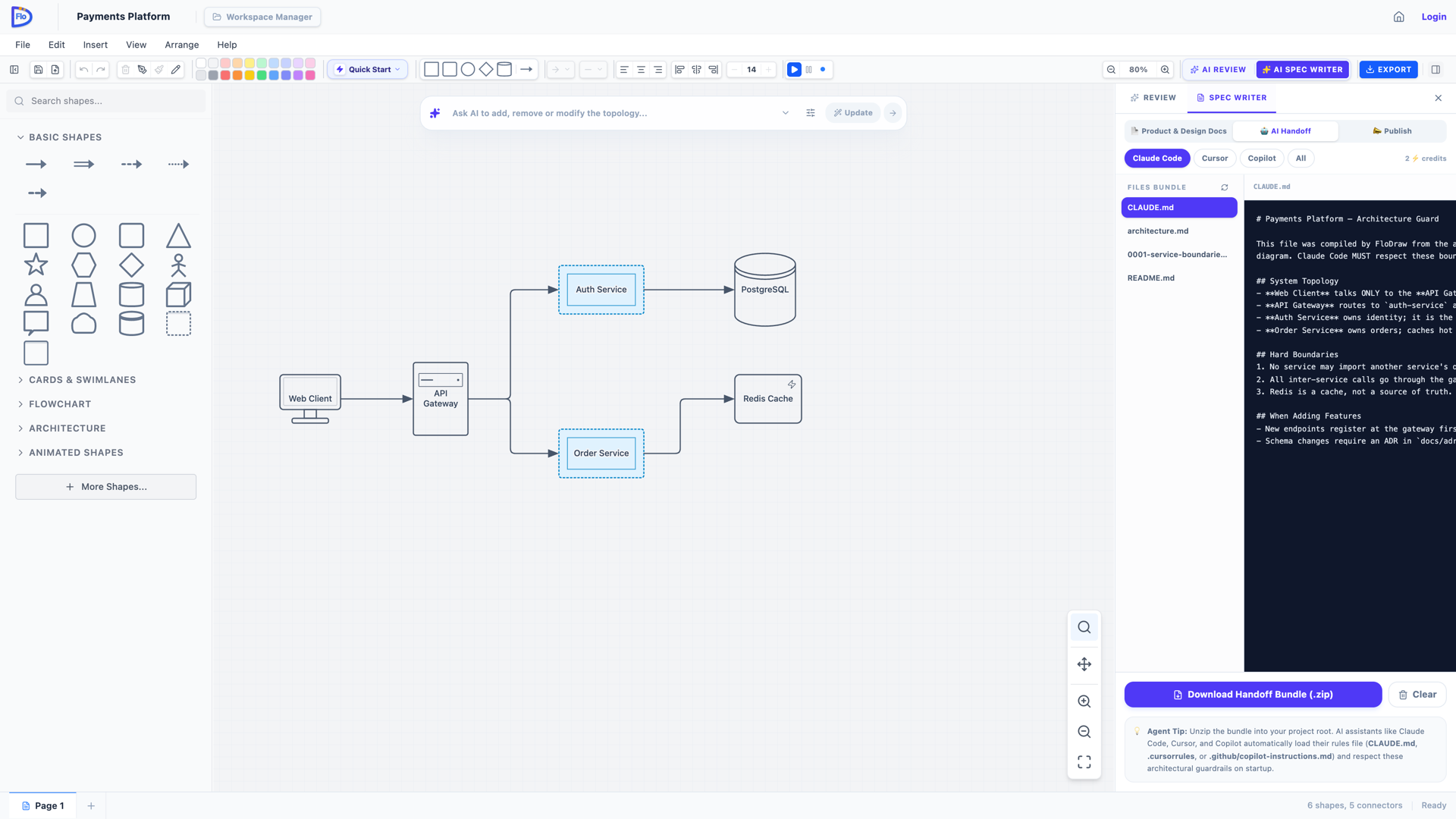
✏️ Try it yourself: open this exact architecture in FloDraw — edit it, then generate your own handoff bundle. Free, no sign-up needed.
Unzip it into your project root and you're done. AI assistants load their rules file automatically on startup — no prompting ritual, no copy-paste. Your agent now knows that the Web Client only talks to the API Gateway, that Redis is a cache and not a source of truth, and that schema changes need an ADR first.
Why Diagrams Beat Hand-Written Rules Files
Could you write a CLAUDE.md by hand? Absolutely. But three things make the diagram-first approach a genuine upgrade:
1. The Diagram Is the Review 🕵️
A visual topology is the easiest artifact for a team to agree on. Everyone can see the boxes and arrows; nobody can see the subtle omission in paragraph four of a hand-written rules file. In FloDraw you can even run an AI Architect Review on the diagram first — so the rules your agents receive encode a design that's already been stress-tested.
2. One Source, Every Tool 🧰
Teams rarely standardize on a single AI assistant. One click with the All option generates rules for Claude Code, Cursor, and Copilot from the same diagram — identical boundaries, three dialects. No more "the Cursor folks have different guardrails than the Claude folks."
3. Drift Dies Here 🔄
Architecture evolves. When it does, you update the diagram — the artifact you were going to update anyway — and regenerate the bundle. The rules file never becomes that stale document from two refactors ago that agents faithfully obey while building the wrong thing.
The New Agentic Workflow, End to End
The Handoff Bundle is the last mile of a workflow FloDraw covers end to end:
- Design the system visually — drag shapes, or prompt the AI, or magic-wand a whiteboard photo into an editable diagram.
- Review it with the AI Principal Architect until the design holds up.
- Compile specs — PRDs and RFCs for humans, the Handoff Bundle for agents.
- Build with your favorite AI coding tool, confident it's coloring inside the lines you drew.
Humans design. Agents implement. The diagram is the contract. 🤝
Try It in Two Minutes
Open FloDraw, sketch even a five-box version of your system, open Studio → Handoff, and generate your first bundle (AI-written rules cost just 2 credits — the compiled architecture docs and ADRs are free). Commit it to your repo and watch your AI assistant suddenly act like it attended your design reviews.
Because in the agentic world, the team that ships fastest isn't the one with the most agents — it's the one whose agents know the architecture. 🚀